The Expanded Analytics

Latchel Analytics has recently undergone a major update, including new functionality, UI changes, powered through Google Looker Studio. These changes significantly improve how property managers access, filter, and understand their data across their Latchel account. The Analytics dashboard is organized into different sections to help you monitor and evaluate your maintenance performance.
Analytics

The Summary Section

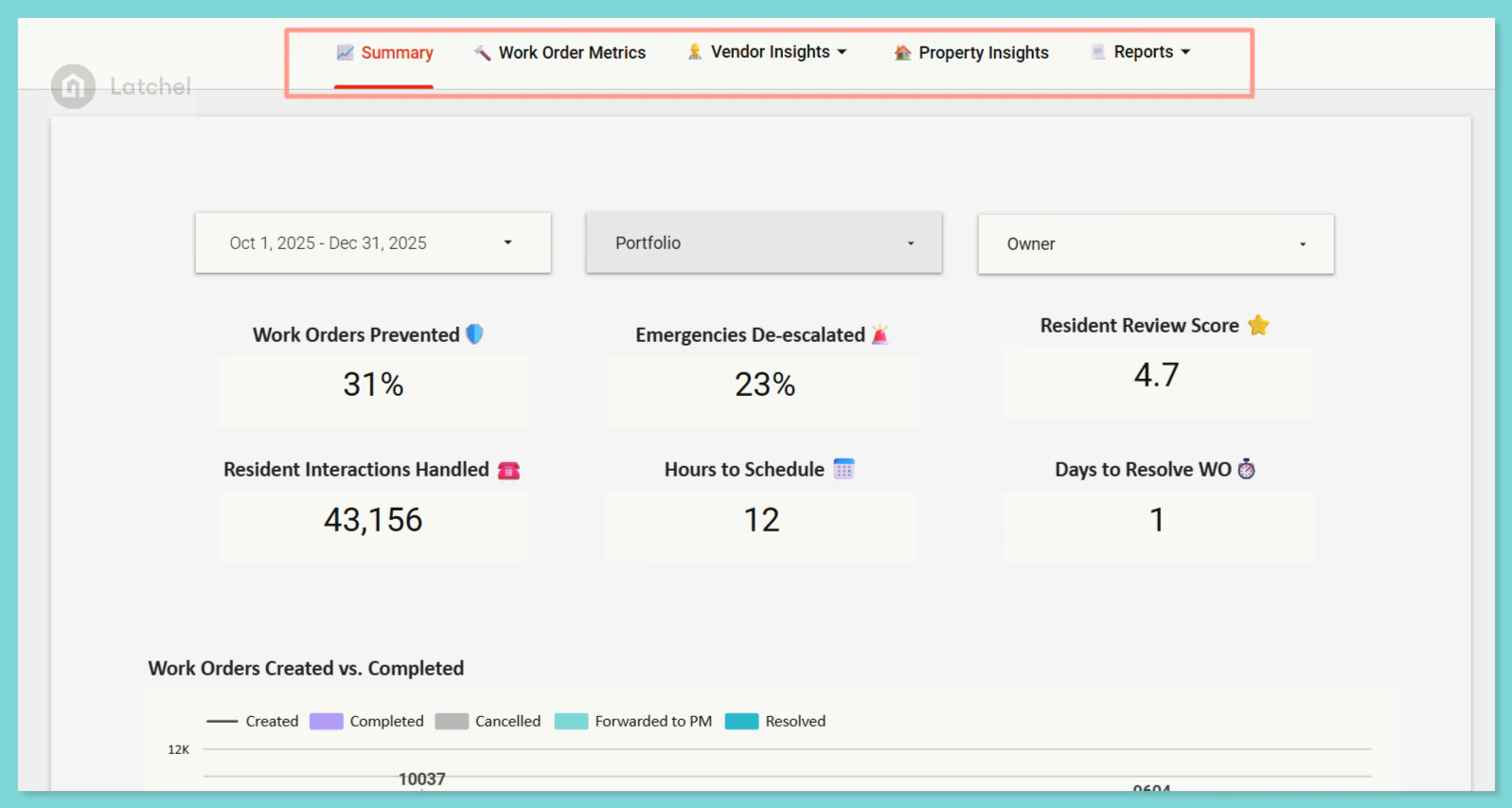
This section contains the 7 key metrics displayed in the main dashboard summary cards and charts.
  1. Days to Resolve WO
This calculates the median number of days it takes to resolve work orders. The resolution occurs when work is complete, not necessarily when the work order itself is completed and invoiced.
Why This Is Important:Work orders that stay open reduce the perceived value of a rental home. If work orders remain open and unresolved for too long then residents are more likely to move out when it’s time for renewals.
  1. Work Orders Created vs. Completed
This tracks the count of work orders created and their final status (completed, cancelled, forwarded to PM) by day and month. It also allows for side-by-side comparison of created work orders versus their status breakdown.
Why This Is Important:This metric visually highlights your operational backlog. By comparing the total work orders created (the inflow) against those completed (the outflow), it pinpoints the exact volume of work orders that remain open and “in progress” each month.
  1. Hours to Schedule
This metric calculates the median time in hours it takes from work order creation to reaching “Awaiting Work Date” state. It also measures scheduling efficiency.
Why This Is Important:Latchel’s data shows the most important factor to determine resident happiness with most maintenance is the time it takes to schedule work. The actual date of the appointment is less important. Think of it as shortening the amount of time the resident is sitting with uncertainty about how long it will take to address their issue. Uncertainty is worse than waiting.This is the most impactful metric to resident reviews assuming your service providers actually show up to scheduled appointments and are empowered to complete necessary repairs on that first visit.
  1. Work Order Prevented
This metrics tracks intake outcomes to identify when issues were resolved during intake without creating a work order versus when work orders were actually created.
Why This Is Important:This shows how many initial work order requests Latchel fielded that did not ultimately result in a work order, either solving the issue or preventing a duplicate or a new work order from being created.
  1. Resident Interactions Handled
This metric aggregates all customer conversations across SMS, call logs, Twilio calls, and intake sessions. Provides a comprehensive view of all interactions with residents.
Why This Is Important:This shows how many interactions with your residents were handled by Latchel and did not have to be fielded by your team.
  1. Emergencies De-escalated
This tracks potential emergency work orders and the percentage that did not result in immediate dispatch. This could be because they were resolved, deferred, cancelled as a duplicate or otherwise de-escalated.
Why This Is Important:This shows the number of work orders that initially appeared like they matched your emergency criteria, but after deeper troubleshooting they were de-escalated or deferred, which saves your company and clients money.
  1. Resident Review Score
This captures resident ratings/review scores for completed work orders. However, this only includes work orders that have received a rating.
Why This Is Important:The number one reason residents choose to move out of a home is because of poor maintenance experiences. The benchmark is a 4.8 / 5.0 star average rating.

Work Order Section

This section contains detailed work order queries and work order-specific metrics.
  1. Work Order Details
This provides comprehensive work order information including property details, resident names, vendor information, problem/category, state, and creator information.
  1. Median Speed to Schedule Appointment
This metric calculates the median time (in hours with decimal precision, e.g., 0.1 hours) between when a job is first offered to a vendor (or assigned if no offer exists) and when the appointment is scheduled. It also measures how quickly vendors schedule appointments after being offered/assigned.
  1. Missed Appointment Rate
This calculates the percentage of work orders that had a confirmed appointment but had a “no show” reported. This metric identifies appointments where the service provider did not show up or where the resident reported issues with the appointment.
  1. Average Work Order Review
This calculates the average work order review score. This is a repeat of the “Resident Review Score” metric from the main dashboard, but shown for reviews given each month based on when the work order was updated (since there is no specific review date field).
  1. Median Work Order Resolution Time
This calculates the median time (in days) between work order creation and the visit time. This metric measures how long it takes from when a work order is created until the service visit occurs.

Vendor Insights Section

This section contains vendor performance metrics and insights. This section provides the top 10 best and worst service providers based on the following:
  1. Vendor Scheduling Time
This identifies the top 10 best-performing and top 10 worst-performing vendors based on their speed to schedule appointments. This metric measures how quickly vendors schedule appointments after being offered/assigned work orders. The same query can be used to generate both rankings by sorting vendors by median hours_to_confirm in ascending order (best) or descending order (worst).
Dashboard Display:🚀 Top Performing: Vendors with the lowest median hours_to_confirm (fastest to schedule)⚠️ Worst Performing: Vendors with the highest median hours_to_confirm (slowest to schedule)
  1. Vendor Missed Appointment Rate
This metric identifies the top 10 best-performing and top 10 worst-performing vendors based on their missed appointment rate (percentage). It also measures what percentage of confirmed appointments were missed (no show) for each vendor. The same query can be used to generate both rankings by sorting vendors by missed appointment rate in ascending order (best = lowest rate) or descending order (worst = highest rate).
Dashboard Display:🚀 Top Performing: Vendors with the lowest missed appointment rate (best performance)⚠️ Worst Performing: Vendors with the highest missed appointment rate (worst performance)
  1. Vendor Average Work Order Review
Identifies the top 10 best-performing and top 10 worst-performing vendors based on their average work order review scores. This metric measures customer satisfaction with vendor performance. The same query can be used to generate both rankings by sorting vendors by average job_rating in descending order (best = highest rating) or ascending order (worst = lowest rating).
Dashboard Display:🚀 Top Performing: Vendors with the highest average job_rating (best customer satisfaction)⚠️ Worst Performing: Vendors with the lowest average job_rating (worst customer satisfaction)
  1. Vendor Median Work Order Resolution Time
Identifies thetop 10 best-performing and top 10 worst-performing vendors based on their median work order resolution time. This metric measures vendor-controllable time— how quickly vendors resolve work orders from assignment/offer to visit time. The same query can be used to generate both rankings by sorting vendors by median days_to_resolve in ascending order (best = fastest) or descending order (worst = slowest).
Dashboard Display:🚀 Top Performing: Vendors with the lowest median days_to_resolve (fastest to resolve)⚠️ Worst Performing: Vendors with the highest median days_to_resolve (slowest to resolve)

Property Insights Section

This section contains property performance metrics and insights.
  1. Properties with the Most Requests
This identifies properties with the highest number of work order requests. This also helps identify properties that require the most maintenance attention.
  1. Top Recurring Issues
This identifies issues that repeated (more than once) at any property. This metric shows which issues are recurring problems, helping identify issues that need attention.
  1. Types of Emergency Work Orders
This metric returns emergency work orders with their LLM-categorized types from the work_order_types table. This query uses AI categorization to group emergency work orders into predefined categories such as “Major Leaks and Flooding”, “Heating/Cooling Issues”, “Sewage/Drainage Backups”, etc.
Why This Is Important:Understanding the types of emergency work orders helps identify patterns and prioritize resources. For example, if “Major Leaks and Flooding” is the most common emergency type, you can focus on preventive maintenance, better vendor relationships, or resident education to reduce these incidents.

Resident Section

This section contains detailed resident information queries.
  1. Resident Details
This provides detailed information about active residents, including their contact information, associated properties, and property owner details.

Properties Section

This section contains detailed property information queries.
  1. Property Details
This provides comprehensive property information including address, owner details, active residents, and integration data. However, this only includes active properties.

Invoices Section

This section contains detailed invoice information queries.
  1. Invoices Details
This provides detailed invoice information including line items, associated work orders, properties, and vendor details. It is useful for financial reporting and invoice tracking.
This article is currently a work in progress.